
How Our UK SME Business Consultancy Works
Engaging external support can feel like a big step. Most business owners already have a strong sense of what isn’t working - the challenge is turning that into clear action and measurable improvement.
This page sets out exactly what working together looks like in practice.
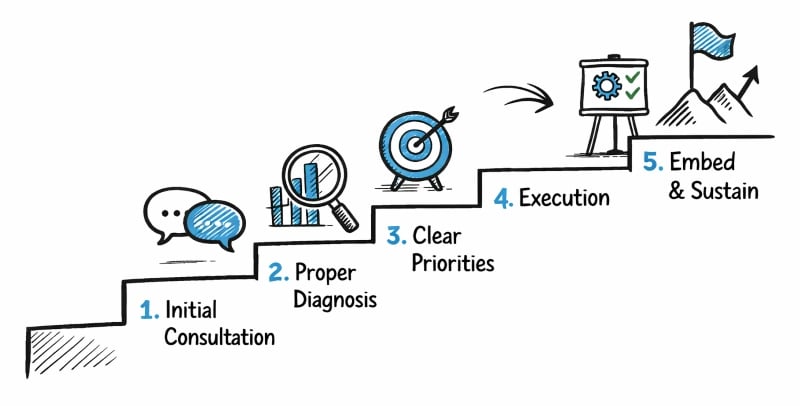
1. Straight Conversation (No Posturing)
We start with a direct discussion about your business.
What’s working, what isn’t, where the pressure is, and what you’re trying to achieve.
This is not a sales exercise. If there’s no clear value in working together, that will be obvious quickly.
If there is, we move forward with intent.
2. Proper Diagnosis (Not Guesswork)
Most businesses operate on assumptions about their problems. That’s where time and money get wasted.
This phase is about getting to the truth.
Typically, this involves:
Reviewing how the business actually operates day-to-day
Understanding roles, responsibilities, and decision-making
Identifying bottlenecks, inefficiencies, and failure points
Challenging existing thinking where it doesn’t hold up
The objective is simple: replace opinion with evidence.
3. Clear Priorities (Ruthless Focus)
Once the real issues are visible, the next step is deciding what actually matters.
Not everything gets fixed. Not everything should be fixed.
We will:
Identify the highest-impact opportunities
Strip out distractions and low-value activity
Define what success actually looks like
Agree a practical plan that can be executed
This is where most businesses fall down. Too many initiatives, not enough progress.
4. Execution (Where Most Consultancy Fails)
Ideas are not the problem, but execution is.
This is where the work happens.
Depending on your situation, this may include:
Working directly with you and your leadership team
Holding people accountable where performance is weak
Redesigning processes and ways of working
Providing structured, ongoing guidance and challenge
This is not hands-off advice. It is active, involved support focused on getting things done.
5. Embed & Sustain (No Regression)
A common concern with consultancy is reliance - bringing someone in, making progress, and then needing them indefinitely to keep things moving.
In fact, many consultancy models create ongoing reliance, but that’s not how we work. Our model is focussed on building capability within your business, not creating dependency on external support.
This means:
Working alongside you and your team, not operating in isolation
Making thinking, decisions, and actions fully transparent
Transferring knowledge as part of the process, not as an afterthought
Strengthening internal ownership and accountability
The objective is simple: your business becomes stronger, more capable, and able to manage itself effectively without constant external input.
Support remains available where needed - but it is no longer required for the business to perform.
Our Consultancy Process
What Working Together Actually Looks Like
Most engagements follow a consistent pattern:
Regular, structured sessions (typically weekly or fortnightly)
Clear focus on specific outcomes, not vague discussion
Direct, honest conversations - including challenge where needed
Ongoing access between sessions when required
You are not buying a report. You are buying momentum, clarity, and execution.
Types of Engagement
Support is shaped around what will actually move the business forward.
This typically falls into one of three categories:
Focused diagnostic & action planning
Short-term, high-intensity work to identify issues and define a clear path forwardTargeted project work
Addressing specific problems such as performance, structure, or process breakdownsOngoing advisory & support
Longer-term involvement to drive sustained improvement and accountability
If a lighter-touch approach will do the job, that’s what we use. If more involvement is needed, that’s what happens.
Recognise
The first step is acknowledging the need for change and improvement
Focus
Identify the key areas and outcomes you want to achieve
Decide
Choose whether to manage internally or bring in expert support
If you already know what needs attention - great.
But if the path forward feels less clear, that’s no barrier. Whether you need a specific project delivered, tailored training, independent advice, a focused workshop, or simply a fresh set of eyes, we can help.


How Clients Typically Arrive Here
Before engaging external support, most business owners go through the same pattern:
If you’re serious about improving the business, the next step is simple.
Have a conversation.
No pitch. No pressure. Just a clear, direct discussion about where you are and whether working together will make a difference.
If it will, we move forward properly, and if it won’t, you’ll know that just as clearly.
The First Step




If you want straight answers and practical action, the next step is a conversation.


Copyright © Aftermarket Advisory Consulting 2026. All rights reserved.
Quick Links
Get In Touch
Based in the UK, supporting businesses worldwide
Expertise
Independent business management consultancy helping SMEs improve customer retention, satisfaction and revenue from existing customers by strengthening post-sale performance and service operations.
Supporting businesses across Bournemouth, Southampton, Hampshire and Dorset, as well as clients across the UK, and worldwide.