

The Empty Chair at the Table
Why the absence of after-sales from the leadership conversation is a systems failure, not an awareness problem
Nigel Woodall
In 1983, Theodore Levitt, then a professor at Harvard Business School and editor of the Harvard Business Review, made an observation that should have fundamentally changed the way businesses are organised. The relationship between a seller and a buyer, he wrote, seldom ends when a sale is made. Increasingly, it intensifies after the sale, and helps determine the buyer's choice the next time around.
That was over forty years ago.
In 2006, Harvard Business Review returned to the same territory. Researchers Cohen, Agrawal and Agrawal published what became one of the more widely cited pieces on aftermarket management. Their opening observation was blunt: executives publicly swear by a services-centric view of the world but privately admit that most companies either don’t know how, or don’t care, to provide after-sales services effectively. Their conclusion was equally direct: top managements the world over treat aftermarket services as a mere afterthought.
That was twenty years ago, but the same issue still exists today.
The real issue is that this has never been an awareness problem. The evidence has been visible for decades, and the people working inside aftermarket functions have understood it from direct (and painful) experience for considerably longer.
In working with SME leadership teams, this issue presents itself in a very consistent way. The importance of after-sales is usually recognised. What’s missing is clear accountability at leadership level for how it actually performs.
That absence sits at the source of the problem. Post-sale performance is left as a shared responsibility, rather than being governed as a commercial system with defined ownership.
Where that ownership is missing, the result is a systems failure, and to fix them, they require deliberate structural change.
Where After-Sales Margin Really Lives
Before addressing why the structural response has been so limited, it’s worth being precise about what’s at stake. BCG’s most recent benchmark study of aftermarket services in industrial manufacturing found that companies prioritising aftermarket generate a third or more of their total income through those activities. Among companies that have developed services into a genuine core capability, high-margin service revenue runs up to nine percentage points above the industry average. Revenue growth from services is now outpacing new equipment sales across the majority of companies surveyed.
These aren’t marginal contributions from an unimportant support function. In many capital-intensive businesses, the after-sales environment is where the business model actually sits. The original equipment is often sold at thin margin, or at a loss. The return on that investment comes from what follows the initial sale: service contracts, parts, upgrades, and the ongoing relationship that determines whether the customer renews or redirects their spend elsewhere. Remove the post-sale revenue stream, and in many cases what’s left can’t sustain the business on new equipment sales alone.
And yet, in too many of the businesses where this dynamic operates, the leadership structure remains shaped almost entirely by OEM and finance backgrounds. There’s clear representation for finance, operations, marketing, and technology. There are now also roles such as Chief Digital Officer and Chief Information Security Officer, disciplines that have earned their place at the table as their strategic importance became visible.
There’s no equivalent for after-sales. No Chief After-Sales Officer, or senior service leader with recognised authority where strategy is set and capital is allocated.
The C-suite has expanded to accommodate disciplines that were once invisible at board level. After-sales hasn’t followed that trajectory. The part of the business that determines whether customers stay or leave has no clear owner in many organisations.
There's a further dimension that makes this leadership gap increasingly consequential. Across capital-intensive sectors, the strategic direction of travel is well established - away from product-led revenue models and toward service-led ones. Equipment margins continue to compress, and competitive differentiation through product specification alone is harder to sustain. The businesses that will define the next decade in these sectors are those that have successfully made the transition from selling a product to delivering an outcome. But that transition is not primarily a sales challenge or a marketing challenge. It's an operational and cultural one, and it's precisely the kind of challenge that requires someone at the top table who has lived it.
A leadership team with deep product and finance experience but no aftermarket representation will evaluate the product to service shift through the wrong lens - assessing it on capital investment logic and sales pipeline metrics, neither of which captures what the transition actually depends on. They won't see that in B2B environments, the post-sale value proposition isn't a single static thing - it's different for every customer, and it changes as each customer's business changes. You cannot build it, price it, or deliver it accurately if you've never operated in that environment. That level of understanding isn't transferable from a dashboard or a market report - it only comes from experience.
The result in too many businesses is a strategic ambition that never quite translates into a functioning service model. Not necessarily because the intention was missing, but simply because the experience to execute it was never in the room.
That absence shapes every downstream decision the organisation makes about its post-sale operation.
The businesses that navigate the product to service transition successfully won’t do so through better processes or smarter dashboards. It will be because there’s someone within the leadership team who has the experience to understand what the customer actually needs after the sale - and the authority to build an organisation capable of delivering it.
Why Production Logic Doesn’t Translate to Service
When decisions affecting after-sales are made by leaders without direct experience of that environment, they are evaluated through a lens used for a different kind of business. So, it isn’t a question of competence - it’s simply an inappropriate fit…square pegs in round holes.
This is why applying production logic to after-sales produces outcomes that look efficient but are destructive over time.
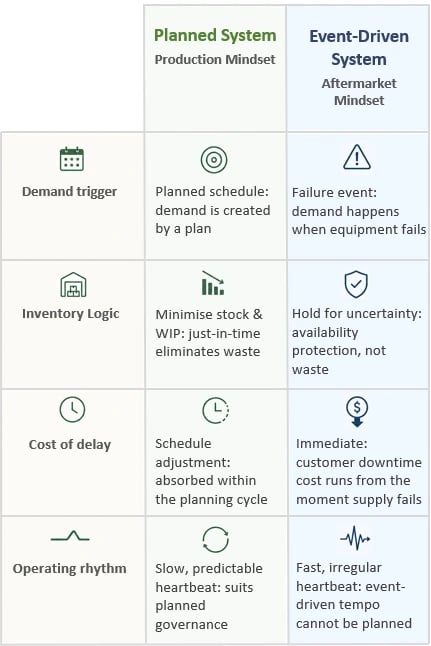
Production environments are built around predictability. Aftermarket service isn’t - demand is triggered by failure events, not plans, and the commercial consequence of delay is immediate.
Applying production logic to that environment produces decisions that appear rational but carry unintended consequences. For example, inventory is optimised for cash efficiency without fully accounting for the commercial consequences of not having a critical part available when it’s needed. Headcount is reduced to improve short-term margins, removing experience and tacit knowledge that can’t be easily replaced, and pricing is adjusted to meet margin targets. All of this happens without recognising the impact on the immediate customer experience, or long-term customer relationships.
Each of these decisions can be justified in isolation. However, cumulatively, over time, they constrain an organisation's ability to deliver the outcomes that customers need and the business depends on, but doesn’t explicitly manage.
How Aftermarket Demand and Inventory Actually Behave
A piece of equipment may operate without issue for months and then fail without warning. When that failure occurs, the part isn’t needed next week. It’s needed now. The cost of downtime is immediate and often significant, and the customer’s tolerance for delay is shaped not by convenience but by the operational and financial consequences of the equipment being unavailable. There’s no forecast window to absorb the gap.
Production forecasting is imperfect but usable, whereas aftermarket forecasting is fundamentally different. Failure rates vary by age, environment, usage, and customer behaviour. Therefore, aftermarket demand is driven by events that are, by definition, unplanned.
The inventory consequences of this are significant, and they sit at the heart of why production-trained leadership consistently misreads aftermarket performance. Production inventory management is built around lean principles - minimise stock, work in progress, and eliminate waste. Just-in-time logic is entirely appropriate in a production context. Applied to aftermarket, the same logic produces an operation that can’t serve its customers when they need it most. Aftermarket must hold inventory against zero firm demand - stocking parts that may not move for months or years, but whose absence at the moment of need carries immediate commercial and relationship cost. The inventory isn’t just larger, it’s also more complex, often spanning thousands of part numbers across decades of installed equipment. A production-trained mind looking at that inventory sees waste. An aftermarket-trained mind sees availability insurance, and the ability to protect margin when it matters most.
And then there’s the rhythm problem. Production runs to a plan, whereas aftermarket demand is highly variable. When both functions sit under the same leadership, governance attention, investment priorities, and performance frameworks naturally align to the slower, more familiar heartbeat. Aftermarket gets managed through a lens calibrated for a rhythm at which it doesn’t operate. Service levels begin to erode, lead times extend, and customers adjust their buying behaviour - sometimes gradually through reduced reliance, sometimes decisively by exclusively sourcing elsewhere. By the time the impact is visible in renewal rates or revenue, the underlying causes are already dispersed across multiple decisions.
That last point is the one that matters most. The misalignment isn’t primarily a technical failure, and it’s not because those people lack capability. It’s simply because the person who understands the aftermarket environment isn’t in the room when the decisions are made. So, this is a leadership failure, and such failures don’t resolve themselves through better data or improved processes. Instead, they require someone at the table with the authority and the experience to make the case for a different approach…and for them to be heard.
Aftermarket doesn’t operate on forecast horizons. It operates on failure events. The inventory policy, the service model, and the governance framework all need to be designed around that reality - not borrowed from a discipline that assumes demand can be planned.
After-Sales Underperformance: A Governance Problem, Not an Awareness Gap
Once you look at it structurally, it’s not difficult to explain why this persists.
What’s missing is the authority to resolve the challenges at the level where they actually sit.
The most significant constraints on post-sale performance don’t sit within individual functions. They sit between them: the handover from sales to service; the alignment between pricing and delivery; the visibility of cost-to-serve, and the integration of retention into commercial strategy. These aren’t issues that can be resolved through local optimisation, as they require decisions that cut across organisational boundaries.
Without representation where those decisions are actually made, the system defaults to fragmentation: sales optimises for new acquisition; operations optimises for delivery, and finance optimises for control. Each function performs its role, but the interaction between them isn’t governed as a single commercial system. The consequence lands squarely on the customer - and on the people responsible for serving them, who are left trying to knit together the outputs of functions that were never aligned in the first place.
That’s why the problem persists. It isn’t because it’s poorly understood. It’s because it isn’t structurally owned
What an Effective After-Sales Operating Model Actually Requires
The question then is what structural ownership actually requires. Addressing this isn’t a matter of incremental improvement. It requires a shift in how the post-sale business is defined and governed.
In practice, a defined post-sale operating model brings three things together that are usually managed separately.
First, revenue durability. Retention, renewal, and expansion are treated as managed financial outcomes, not as a given. Performance is tracked at account and segment level, and ownership is clearly defined.
Second, operational alignment. Service delivery, inventory strategy, and resource planning are designed to support those revenue outcomes. Decisions are made with an understanding of both cost and consequence.
Third, cost integrity. Cost-to-serve is visible, understood, and actively managed. Margin isn’t assessed only at aggregate level, but in relation to the individual customers and segments that generate it.
A small number of organisations have already worked this out in practice. The Revenue Integrity Model is simply a proven method of applying that thinking. It brings revenue, operations, and cost into a single post-sale system with clear components and a defined progression path from reactive to structured, and ultimately to engineered performance.
At the structured stage, organisations begin to align service tiers commercially, understand cost-to-serve at segment level, and manage retention and expansion systematically. At the engineered stage, post-sale is treated as a commercial system in its own right. Retention informs acquisition strategy, and pricing reflects relationship value. Consequently, cash flow becomes more predictable because the underlying drivers are actively governed.
However, this transition won’t happen via isolated initiatives. It requires deliberate design, supported by senior leadership authority that can actually be exercised.
The Commercial Cost of Getting After-Sales Leadership Wrong
The evidence has been consistent for over forty years. Levitt named the commercial logic in 1983. Cohen and colleagues documented the management failure in 2006. The installed base data, the margin analysis, the retention economics, and yet none of it has produced the structural response the argument demands.
The businesses that will compound value over the next decade aren’t necessarily those with the strongest product or the most aggressive growth targets. They are the ones that have recognised what the evidence has always shown: that the relationship doesn’t end at the point of sale, that the margin lives in what follows, and that governing that reality requires someone at the table with the authority and the experience to do so. This can’t be achieved by a working group, or a dashboard…it needs a seat, an owner, and accountability that runs to the boardroom itself.
The question is no longer whether the issue exists. It’s whether leadership teams are prepared to accept that the way they are currently governing the business is producing outcomes they don’t fully see, and in many cases don’t fully understand.
In your business, who is accountable for what happens after the sale, and who their decisions are driving away? Who owns customer retention as a financial outcome? Who has visibility of cost-to-serve at account level? Who ensures pricing reflects the value of the relationship, not just the cost of delivery?
In most organisations, the answers to those questions are partial at best.
The chair is empty, but the decisions are still being made.
If this has prompted questions about your own business, two options are available. The After-Sales Readiness Diagnostic provides an immediate structured assessment. Alternatively, if you'd prefer to talk it through directly, an initial conversation is always without obligation.
hese perspectives draw on work across multiple sectors and themes developed over time, including those set out in After-sales Excellence: Driving Improvement, Customer Satisfaction, and Growth - by Nigel Woodall.
Want More Insights?
Visit our Insights Hub to explore other leadership and growth articles, and explore our free to use tools.
[Take the Diagnostic] or
Copyright © Aftermarket Advisory Consulting 2026. All rights reserved.
Quick Links
Get In Touch
Based in the UK, supporting businesses worldwide
Expertise
Independent business management consultancy helping SMEs improve customer retention, satisfaction and revenue from existing customers by strengthening post-sale performance and service operations.
Supporting businesses across Bournemouth, Southampton, Hampshire and Dorset, as well as clients across the UK, and worldwide.